
News
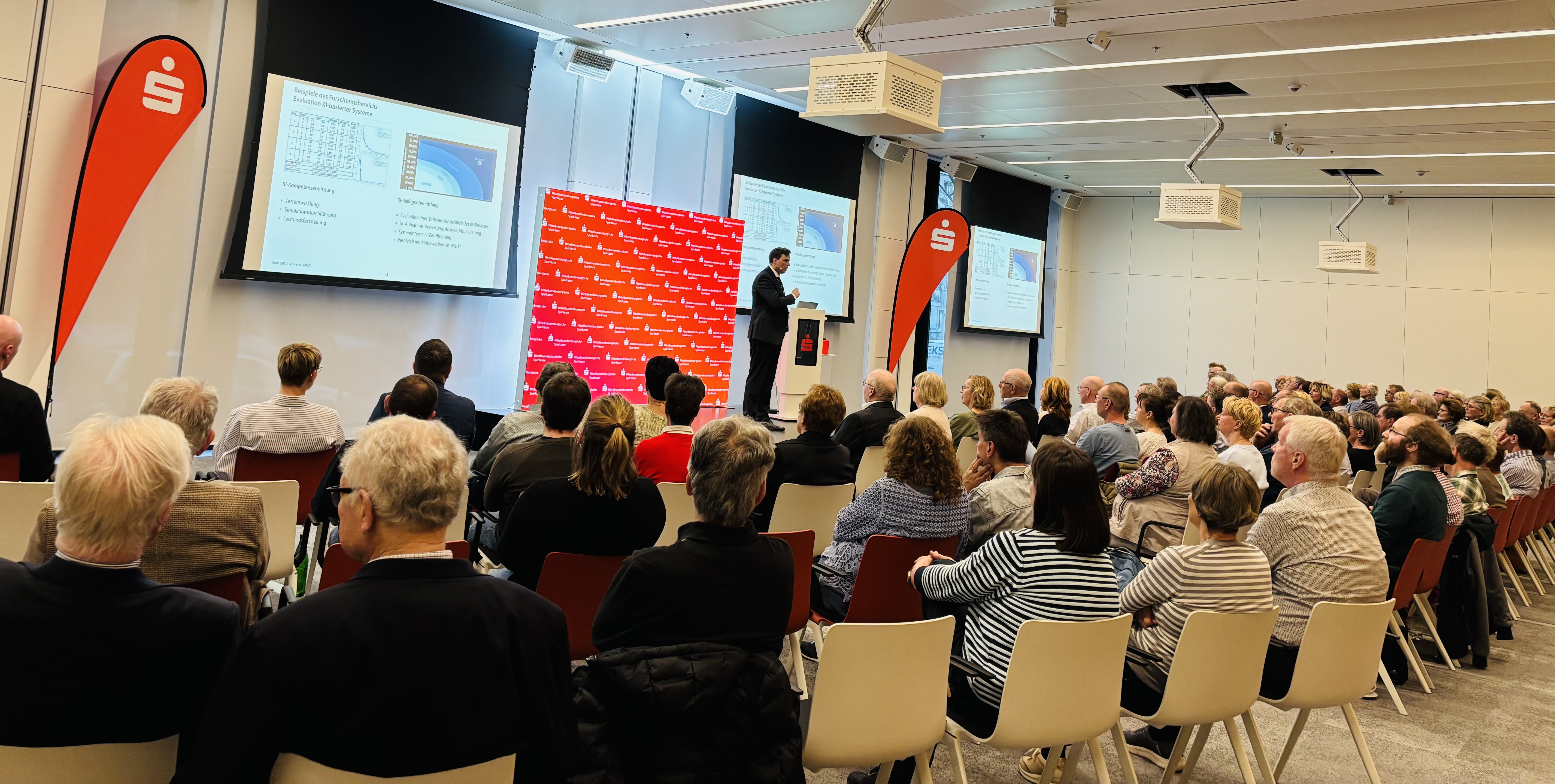
What is AI and Its Impact on Society – Prof. Dr.-Ing. Grum at Mittelbrandenburgische Sparkasse
What is AI and Its Impact on Society – A Contribution of AI-Based Application Systems
On March 11, 2026, Prof. Dr.-Ing. Marcus Grum presented key insights into artificial intelligence and its societal implications at the headquarters of Mittelbrandenburgische Sparkasse in Potsdam. The presentation focused on understanding AI beyond buzzwords and exploring its role in shaping modern society, organizations, and decision-making processes.
We would like to sincerely thank Mittelbrandenburgische Sparkasse Potsdam for the invitation, the excellent organization, and the engaged audience. The discussions clearly showed that AI is not only a technological topic but a central societal issue with far-reaching implications for industry, administration, and everyday life.
Understanding Artificial Intelligence
A central part of the presentation addressed the fundamental question: What is artificial intelligence? AI can be understood as the automation of intelligent behavior and the attempt to imitate or augment human decision-making through computational systems.
It is important to distinguish between artificial intelligence, machine learning, and deep learning. While machine learning focuses on enabling systems to learn from data, deep learning utilizes complex neural network structures to model highly sophisticated patterns and behaviors.
These distinctions are crucial for understanding both the capabilities and limitations of AI systems, especially in societal contexts where expectations and concerns often exceed current technological realities.
Motivation: Learning from Nature and Complex Systems
The presentation illustrated how AI development is inspired by natural systems such as ant colonies, slime molds, and the human brain. These systems demonstrate how decentralized units can collectively create efficient, adaptive, and resilient structures.
For example, ant colonies coordinate through simple signals, while slime molds can form highly efficient transport networks. Similarly, the human brain continuously learns and adapts, enabling complex reasoning and decision-making processes.
These biological analogies provide important insights into how AI-based application systems can be designed to learn, adapt, and optimize behavior in complex environments. In this presentation, a special focus has been put on complex financial environments that are relevant for investors.
AI in the Context of Finance and Banking
A key message of the presentation was that AI must always be understood within its societal and economic context—especially in the financial and banking sector. AI technologies influence and are influenced by financial institutions, their customers, regulatory environments, and broader economic systems.
The interaction between technology, financial markets, and society creates new opportunities but also significant challenges. These include ensuring transparency in automated decision-making (e.g., credit scoring), fairness in customer treatment, regulatory compliance, risk management, and maintaining trust in increasingly digital financial services.
AI-based application systems therefore act as a critical interface between data, financial decision-making, and real-world impact. They connect technical capabilities such as data analysis and prediction with banking processes like lending, investment decisions, fraud detection, and customer interaction—while directly shaping the experiences and outcomes for clients.
AI-Based Application Systems as a Societal Enabler
AI-based application systems provide the foundation for transforming data into meaningful decisions and measurable impact. They enable the monitoring, analysis, and optimization of complex processes across industries and institutions.
- They support autonomous detection of complex relationships,
- enable continuous learning and improvement,
- and connect digital infrastructures with real-world processes.
This makes them a key enabler for digital transformation, especially in areas such as production systems, enterprise software, and public-sector applications.
Impressions from the Event
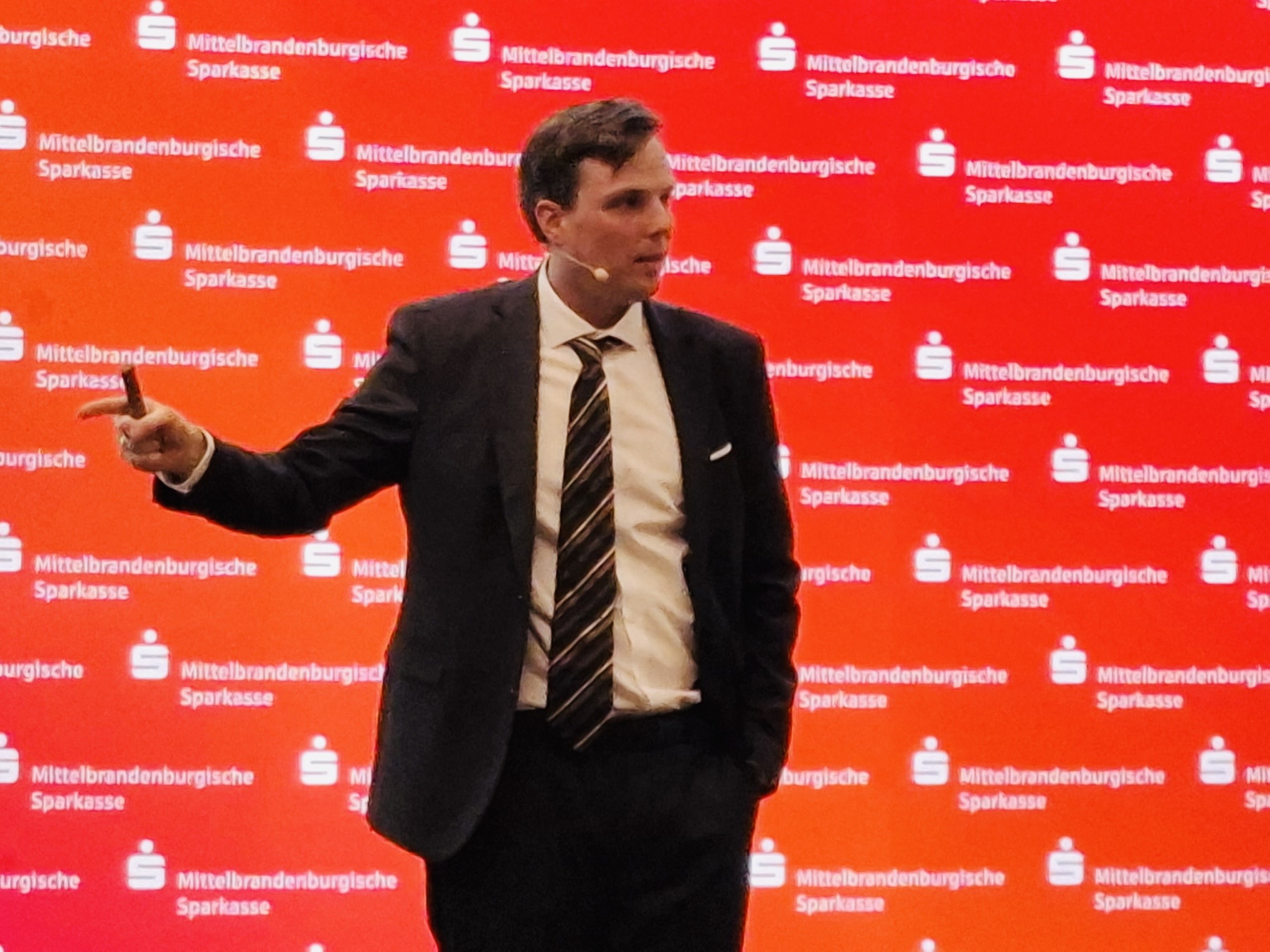

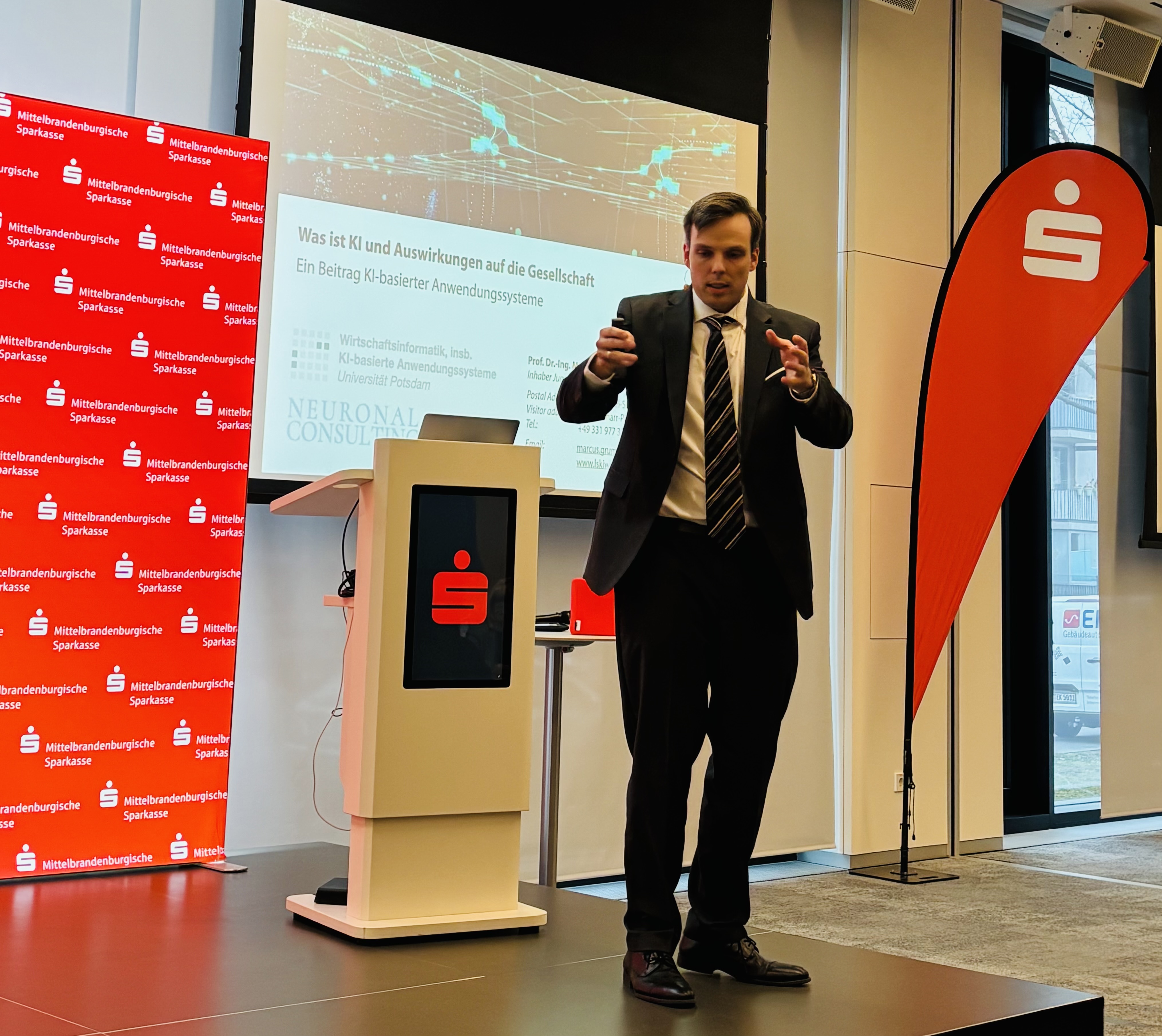
Discussion and Societal Impact
The audience engaged in intensive discussions on the implications of AI for society. Key topics included the impact of AI on finance, investement decision-making processes, and portfolio organizational structures.
A central takeaway was that AI should not be seen as a replacement for human decision-making, but as an augmentation that enhances human capabilities. The concept of human-AI symbiosis plays a crucial role in this context.
At the same time, the importance of transparency, explainability, and responsible AI governance was emphasized as a prerequisite for trust and societal acceptance.
From Theory to Practice
The presentation also demonstrated how AI-based application systems can be implemented in practice. From asset simulation environments to real-world stock exchanges, these systems can be tested, validated, and continuously improved.
This practical orientation is essential for bridging the gap between academic research and real-world applications, enabling organizations to adopt AI in a meaningful and sustainable way.
Closing and Acknowledgements

We would like to thank all participants for their interest, questions, and valuable discussions. Events like this highlight the importance of dialogue between research, industry, and society.

We look forward to continuing these discussions and to further collaborations that explore the role of AI-based application systems in shaping a sustainable, responsible, and innovative future.
Getting-in-Contact
Services
Address
- + 49 (331) 977 3232
- hello@paibis.de
- Karl-Marx-Straße 67, 14482 Potsdam, Germany.