
News
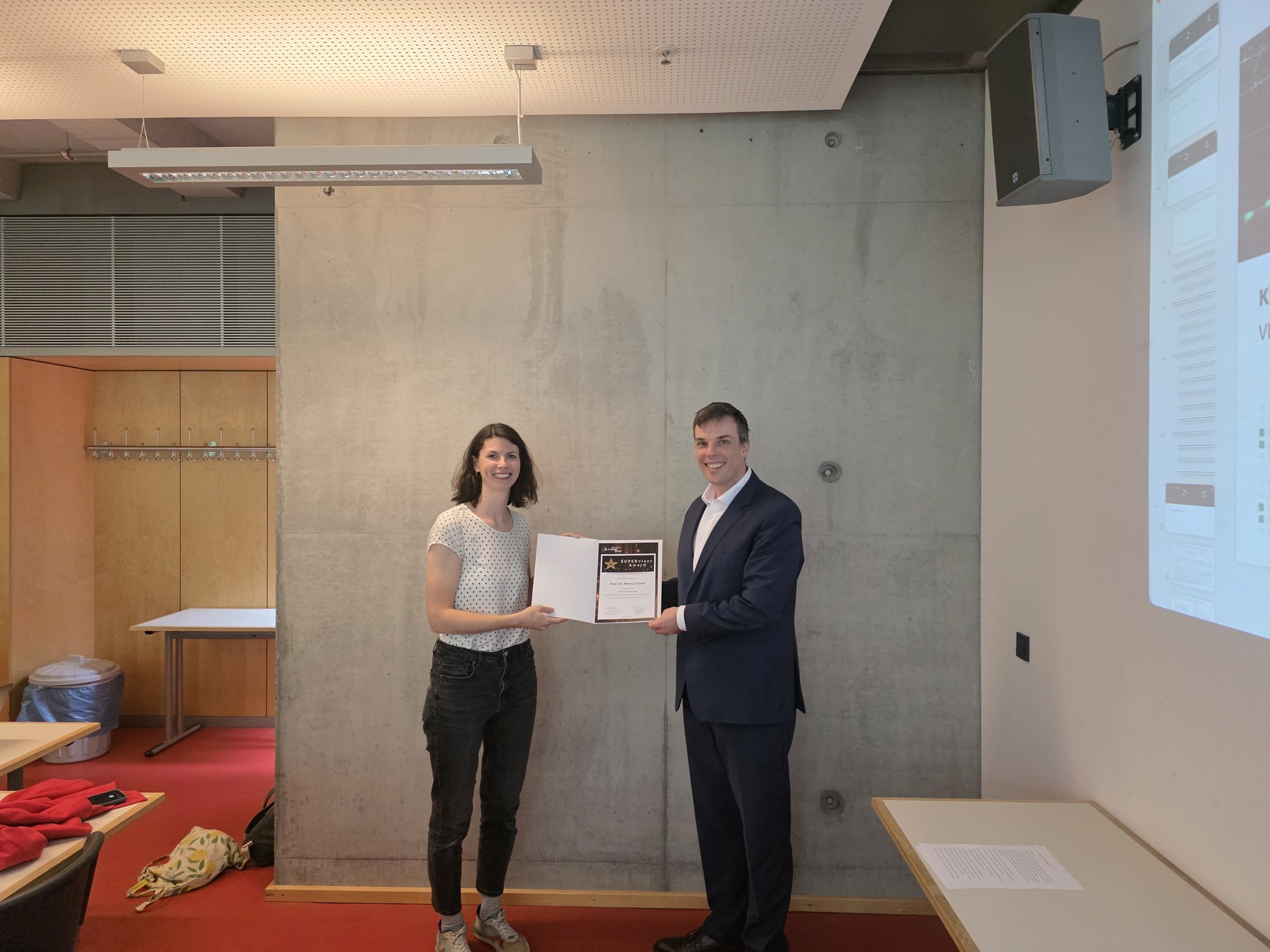
SUPERvisor Award 2026 of the Potsdam Graduate School
An Award That Walked Into the Lecture Hall
The last session of a lecture is usually a quiet affair: open questions, exam organisation, goodbyes. On 9 July 2026, the final session of KIBAS – AI-Based Application Systems took a different turn. Halfway through, the door opened and a delegation from the Potsdam Graduate School walked in – with a certificate.
They had come to present the SUPERvisor Award 2026 to Prof. Dr.-Ing. Marcus Grum – the Graduate School’s award for excellent academic supervision of doctoral researchers. Neither the date nor the place had been announced. The surprise was part of the plan.
Why the Lecture Hall
Awards of this kind are usually handed over at a ceremony, among colleagues who already know each other. The team chose a different room on purpose. The people sitting in a Bachelor lecture on AI-based application systems are exactly those who will decide, in a year or two, whether an academic career is for them – and where.
So the message was addressed to them rather than to the recipient: at this chair, doctoral researchers are supervised well enough that they nominate their supervisor for it. That is a claim no chair can credibly make about itself. It is considerably more convincing when it arrives in the form of a certificate, carried into the room by people from outside.
The handover during the final session of the KIBAS lecture
An Award Given by Those Being Supervised
What makes the SUPERvisor Award unusual is who decides it. The nominations come from the doctoral researchers themselves; they describe how they are supervised, and the jury of the Potsdam Graduate School evaluates those accounts. This year the jury added an explicit commendation.
Being recognised by the people the supervision is actually for – in front of the students who may one day be in their place – is an honour, and it was a genuine pleasure.
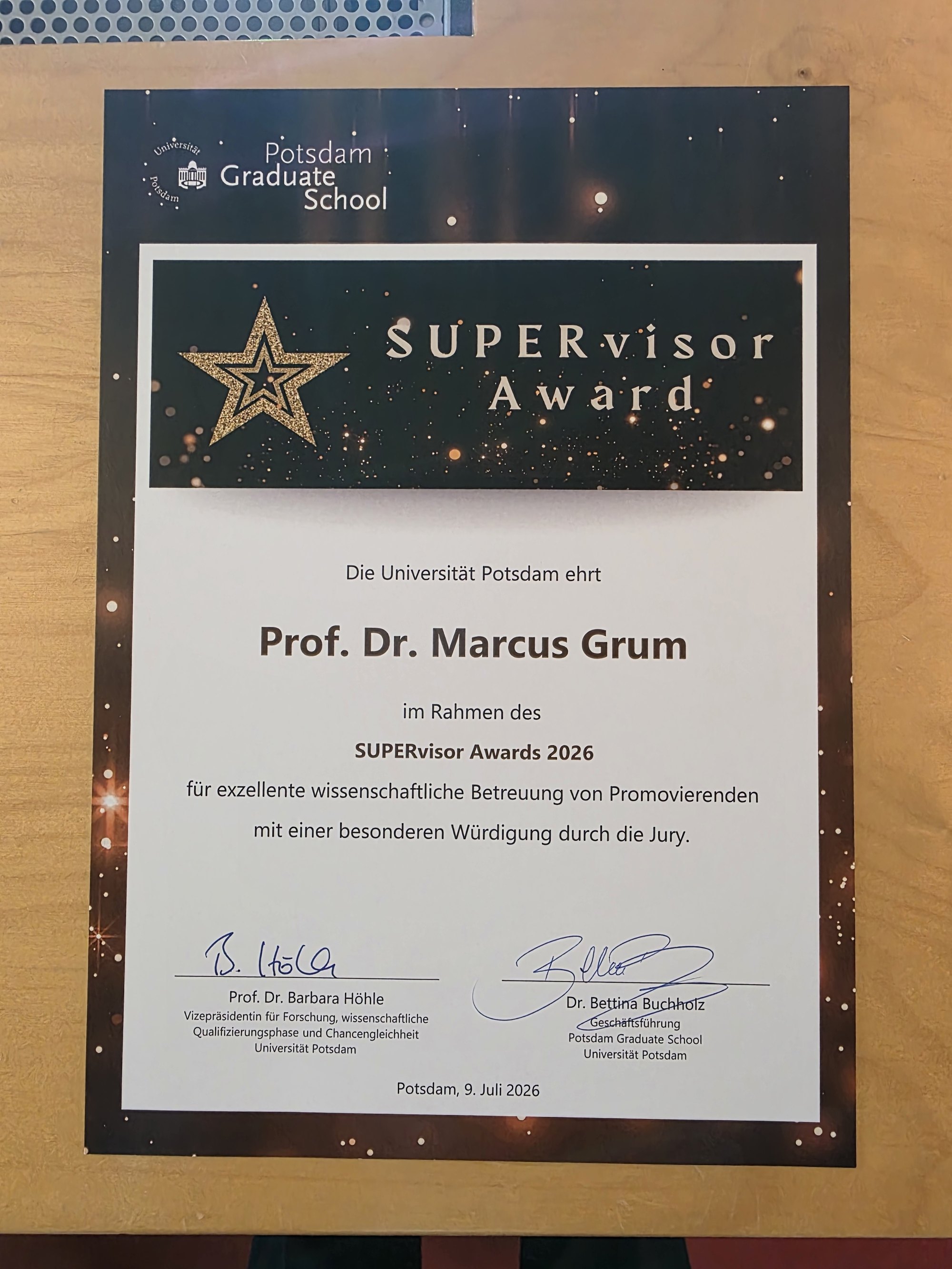
SUPERvisor Award 2026 certificate, Potsdam Graduate School
Supervision as a Research Practice
Behind the award stands a way of working that is not particularly spectacular. Doctoral researchers here should not only produce a thesis, but learn how research is done – how a question is sharpened, how an artefact is built and evaluated, how results survive review, and how findings reach practice.
Internal and external doctoral researchers work on the same research lines, which keeps industrial questions and academic rigour in the same room. Supervision is not a series of appointments, but a shared workbench: papers are written together, artefacts are built together, and rejections are read together.
Thanks
Our thanks go to the doctoral researchers who nominated the chair, to the jury and the Potsdam Graduate School for an award that puts supervision – usually the least visible part of academic work – into the spotlight, and to the team that went to the trouble of organising the surprise.
Getting-in-Contact
Services
Address
- + 49 (331) 977 3232
- hello@paibis.de
- Karl-Marx-Straße 67, 14482 Potsdam, Germany.